
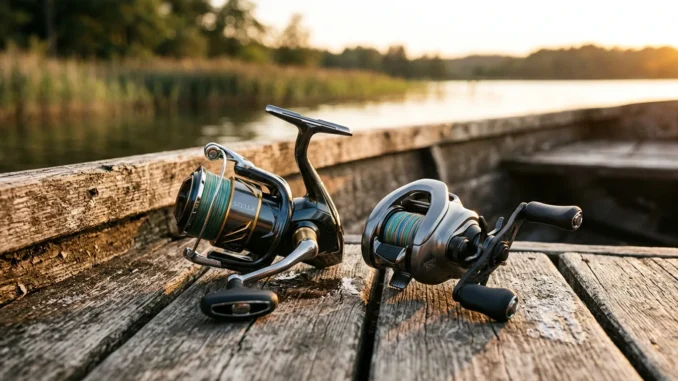
Decoding the Reel Deal: Spinning vs. Baitcasting
Walk into any tackle shop or browse online, and you’re immediately hit with a dizzying array of fishing reels. Two types stand out as the most common, and often the most confusing for newcomers: the spinning reel and the baitcasting reel. Many anglers agonize over which one to choose, wondering if they’re making the “right” decision. Honestly, there’s no single “best” reel for everyone. It’s all about what feels right for you, what you’re fishing for, and what kind of fishing experience you’re after. As someone who’s spent over two decades tangling with everything from panfish to pike, I’ve used both extensively, and I’m here to break it down simply, so you can pick the perfect partner for your fishing adventures.
This isn’t about one being superior; it’s about understanding their strengths and weaknesses to match them to your needs. If you’re an apartment dweller looking for a relaxing weekend escape, or an office worker wanting to improve your catch rate, getting the right reel can make all the difference between a frustrating afternoon and a truly enjoyable one. So, let’s cast off the confusion and reel in some clarity.
The Spinning Reel: Your Go-To for Simplicity and Versatility
For most beginners, the spinning reel is where the journey begins, and for good reason. It’s incredibly user-friendly, forgiving, and versatile. Imagine you’re out on a local pond, just wanting to cast a worm or a small lure a decent distance without much fuss – that’s the spinning reel’s wheelhouse.
How a Spinning Reel Works
A spinning reel is an open-face reel where the spool – the part that holds your fishing line – remains stationary during the cast. Instead, a metal arm called the bail pivots, allowing the line to unspool freely when open, and then winds it back onto the stationary spool when closed. This design virtually eliminates line twists and tangles during the cast, making it incredibly simple to operate.
- Ease of Use: This is its biggest advantage. Learning to cast with a spinning reel is intuitive. You open the bail, hold the line with your finger, cast, and then close the bail to start retrieving.
- Light Lure Handling: Spinning reels excel at casting very light lures and baits, which would be difficult or impossible to cast accurately with a baitcaster. Think small jigs, tiny spinners, or a simple live worm.
- Versatility: A good spinning reel can handle a wide range of fishing situations, from small panfish and trout in freshwater to snapper and small reds in saltwater.
- Drag System: Spinning reels have a drag system, usually a knob on the front or rear of the spool, which allows line to be pulled off under pressure, preventing your line from breaking when a fish pulls hard. Learning to set your drag properly is crucial for any type of fishing!
For beginners, I often recommend a 6–7 foot medium-light to medium power spinning rod paired with a 2500–3000 size spinning reel. Spool it up with 6–12 lb monofilament line – monofilament is forgiving with its stretch and easy to tie knots with. This setup is perfect for targeting species like Largemouth Bass, Trout, Crappie, Perch, and even smaller Catfish in most local waters.
Diving into the Baitcasting Reel: Power, Precision, and a Learning Curve
Now, let’s talk about the baitcasting reel. If the spinning reel is the friendly, easy-going companion, the baitcaster is the high-performance sports car of fishing reels. It offers unparalleled control and power, but it demands a bit more skill from the driver. Honestly, I love my baitcasters for specific situations, but they definitely require some practice.
How a Baitcasting Reel Works
Unlike a spinning reel, a baitcasting reel features a revolving spool that spins during the cast and retrieve. The line comes straight off the top of the spool. To cast, you press a thumb bar to disengage the spool, then use your thumb to control the line as it leaves the spool. This thumb control is the secret to its precision and also the source of its biggest challenge.
- Precision and Accuracy: With practice, baitcasters allow for incredibly accurate casts, letting you drop a lure exactly where you want it – under an overhanging tree limb or next to a submerged log.
- Power and Control: Baitcasters are designed to handle heavier lines and lures, making them ideal for targeting larger, more powerful fish. They also offer greater cranking power for pulling fish out of heavy cover.
- Feel and Sensitivity: Because the line comes straight off the spool and you often have direct contact with the line with your thumb, baitcasters can offer a heightened sense of feel, allowing you to detect subtle bites.
- Learning Curve (The Backlash): The infamous “bird’s nest” or backlash is what scares many beginners away. This happens when the spool spins faster than the line is leaving, causing a tangled mess. Mastering the thumb control and adjusting the reel’s internal brakes (magnetic or centrifugal) and spool tension knob is key to preventing this.
For someone venturing into baitcasting, I’d suggest a 6.5–7.5 foot medium-heavy to heavy power baitcasting rod. Spool it with 10–20 lb braided line. Braided line offers superior strength-to-diameter ratio, no stretch for increased sensitivity, and helps cut through weeds. This setup shines when throwing larger lures like crankbaits, spinnerbaits, or jigs for bigger Largemouth Bass, Pike, Musky, or heavier saltwater species.
Spinning vs. Baitcasting: A Head-to-Head Comparison
So far, we’ve covered the basics of each reel. Now, let’s get to the really critical point: a direct comparison to help you decide. There are distinct advantages to each, and understanding them will make your choice much clearer.
Ease of Use:
- Spinning: Undisputed champion for beginners. Simple to learn, forgiving of mistakes, and minimal tangles.
- Baitcasting: Requires significant practice and skill. The learning curve can be steep, especially when dealing with backlash.
Casting Performance:
- Spinning: Excellent for casting light lures and baits. Good distance, but generally less accurate than a mastered baitcaster.
- Baitcasting: Superior accuracy and control for experienced users, especially with heavier lures. Can cast longer distances with practice.
Lure and Line Management:
- Spinning: Handles light lines (4-10 lb) and light lures (1/16 oz to 1/2 oz) with ease. Less prone to line twists.
- Baitcasting: Best with heavier lines (10-25 lb) and heavier lures (1/4 oz and up). Can struggle with very light lures, leading to more backlash.
Power and Control:
- Spinning: Good for general purpose and smaller to medium-sized fish. Less torque for pulling big fish out of heavy cover.
- Baitcasting: More powerful gears and direct line pull provide superior torque and control for fighting larger, stronger fish and pulling them from dense vegetation.
Cost:
- Spinning: Entry-level spinning combos are generally more affordable and readily available, making them a great budget-friendly option for getting started.
- Baitcasting: Quality baitcasting setups tend to be more expensive, and the learning curve might mean you want to invest a bit more to avoid frustration with cheaper, harder-to-tune reels.
Making Your Choice: Which Reel Fits Your Fishing Style?
Now that you understand the fundamental differences, it’s time to make a decision. But what would you do in this situation? Instead of just telling you what to buy, let’s look at it through the lens of your personal fishing goals and experience.
Choose a Spinning Reel if:
- You’re a complete beginner: This is a no-brainer. Start here to build confidence and basic casting skills.
- You’re targeting smaller fish: Panfish (bluegill, crappie), trout, smaller bass, or perch are perfect for a spinning setup.
- You primarily use light lures or live bait: Small jigs, worms, minnows, or tiny spoons are easily cast with a spinning reel.
- You value simplicity and ease of use: You just want to relax and fish without wrestling with complicated gear.
- You’re fishing in tight spots where accuracy isn’t paramount, but ease of getting a cast off is.
Choose a Baitcasting Reel if:
- You’re an intermediate angler ready for a challenge: You’ve mastered spinning and want to elevate your game.
- You’re targeting larger, harder-fighting fish: Big Largemouth Bass, Pike, Musky, Catfish, or heavier saltwater species.
- You frequently use heavier lures: Large crankbaits, spinnerbaits, heavy jigs, or big topwater plugs.
- You need pinpoint accuracy: For example, casting into specific pockets of cover or under docks.
- You want maximum control during the fight: The direct power of a baitcaster gives you more leverage over strong fish.
In my opinion, every angler should eventually have both. There are days when a light spinning combo is exactly what the situation calls for, and other days when you need the brute force and precision of a baitcaster. Don’t feel pressured to pick just one forever, but for your first step onto the water, simplicity often wins.
Common Beginner Mistakes to Avoid
Regardless of which reel you choose, there are a few pitfalls new anglers often stumble into. Knowing them beforehand can save you a lot of frustration.
- Forgetting to Set the Drag (Spinning & Baitcasting): This is paramount! If your drag is too tight, your line will snap. Too loose, and you’ll never tire out a fish. Always test it before you start fishing.
- Overfilling the Spool (Spinning): Putting too much line on a spinning reel is an express ticket to tangles. Leave a small gap (about 1/8 inch) from the lip of the spool.
- Ignoring Spool Tension & Brakes (Baitcasting): Many beginners try to cast a baitcaster without properly adjusting these. The spool tension knob (usually next to the handle) should allow your lure to fall slowly when disengaged, and the internal brakes should match your lure weight. Learn to dial these in!
- Using the Wrong Line for the Reel/Lure: Don’t put heavy braid on a small spinning reel meant for light mono, or try to cast a tiny 1/8 oz lure with a baitcaster spooled with 20 lb fluorocarbon. Match your line to your gear and target.
- Trying to Cast Too Hard: With either reel, casting isn’t about brute force. It’s about a smooth, controlled motion. A gentle lob often goes further and more accurately than a wild heave.
Ultimately, the best reel for you is the one that you feel most comfortable and confident using. Don’t let complicated terminology or the opinions of seasoned pros intimidate you. Start simple, learn the ropes, and then expand your arsenal as your skills grow.
Leave a Reply